
MY COALITION COUNSELOR ADVICE
Applying to College
College applications have many components. Learn about each part and how and when to apply.

Explore our articles:

Test policies vary from school to school, so it’s important to review the information provided by each of the schools on your list . If you have questions about a college’s test policy, get in touch with its admissions office directly. Admissions officers want to help you make the best decisions!
If you are taking the SAT or ACT, read on for information about these tests and how to prepare for them.

As you research and apply to colleges, you may hear the term demonstrated interest without much explanation. Understanding what it means—and what it doesn’t—can help you focus your time and energy in ways that are actually useful.

Many college applications will ask you some version of, “Why do you want to attend this college?” At first, it can feel straightforward, but students often find it’s one of the hardest questions to answer well.
Admissions counselors aren’t looking for perfect answers or praise about the institution. They’re looking for thoughtful, specific reasons that show you’ve taken time to understand the college.

Admissions counselors understand that this is new territory. The goal isn’t to ignore AI—or assume misuse—but to help students approach the college essay with honesty, integrity, and confidence.

As a high school student, you may feel pressured to choose a college major. You might wonder, “what if I pick the wrong one?” or “does my major decide the rest of my career?” While your major can play an important role in your career journey, it’s not the only factor. Here, we’ll give you an inside look on how careers and majors align and how you can make thoughtful decisions about your major.
If you’re considering taking a break after graduating high school and before starting college, you’ve probably heard about gap years. A gap year is a break — usually a year — between high school and college to explore interests, gain experience, or prepare for the next step in life. But how do you know if a gap year is right for you? Let’s break it down.

Applying to college, while exciting, can feel overwhelming. Staying organized is the key to reducing stress and staying on track during the college application process. Whether you’re just starting your college search or preparing to hit “submit” on applications, these tips will help to keep you organized through the process like a pro.

If you’re considering a career in law, your undergraduate years are an important first step. While there’s no single formula for getting into law school, the choices you make about your major, college, and extracurricular activities can lay a strong foundation for success. Here's what you need to know.

If you’re dreaming of one day becoming a doctor, the first major step is choosing the right college, major, and program for an undergraduate degree. These choices will set the foundation for your journey to medical school. Here’s what to consider as you start your college search.

As you’re choosing a college major, you may encounter programs offered in both Bachelor of Arts (B.A.) and Bachelor of Science (B.S.) degree programs. While both are undergraduate degrees, they offer different approaches to learning and career preparation. Here, we’ll explore the differences between the two so that you feel more equipped to select the best program for you and your goals.

So you’ve finished the first draft of your college essay (often called “the personal statement”)? Congratulations! This is an important milestone in your college process.
BUT, did you notice the phrase, “first draft?”

Many students feel like they should know what they plan to major in when they begin the college application process. However, for many students, the choice isn’t obvious, and that can lead to stress, anxiety, and embarrassment during the application process.

There are thousands of colleges out there for you to search through. This can be overwhelming, so we put together a list of the different categories of colleges that you may come across to help you narrow down exactly what you are looking for.

Wondering how to use the Additional Information section of the application and what to include in this open-ended space?

When it comes to answering your college essay questions, you might feel unsure of how to begin. That’s OK! Nearly every high school student gets stuck when it comes to writing their essay. So, how do you get unstuck?

When do I apply to college? Good question!
Simply put: You’ll apply to colleges in 12th grade, and it’s a good idea to be ready to apply by Nov. 1 of your senior year.

A resume is a summary of your academic and personal experiences, including before- and after-school activities, volunteer work, and/or jobs. Most colleges and employers want to see your resume when they’re considering whether or not to admit or hire you.

When you’re applying to colleges, you’ll be asked to provide official documents, such as your high school transcript (a listing of your classes and grades) and SAT or ACT scores (if required).
You might also be asked for letters of recommendation – and you may be wondering what those are and why you need them. Well, we’re here to tell you everything you need to know!

As a high school student, you are all too familiar with deadlines: essay due Jan. 15, lab report due Feb. 2, final project due April 30. These are firm dates when you submit your materials and — phew! —you’re done.

So, you have a college interview coming up … congratulations!
This in-person or online meeting with a representative of the school you’re considering is a great opportunity to showcase you: the person behind the application. And the best way for you to shine during your interview is by being honest, confident, and prepared.
Many (though not all) colleges and universities interview students as part of their application process. It’s a way for them to learn more about you: the person behind the grades, essays, activity listings, and recommendations you may have already submitted.
Your interview will likely be with someone from the admission office, a current student, or a graduate of the college. It might take place at the school, at a nearby meeting place (like a coffee shop), or online through a system like Skype or FaceTime. In any case, think of it as an opportunity to show that you’re so much more than the paperwork you provided.
You’ve done the research and created a college list, but now you have to decide: Where do I apply?
At the Coalition, we’re here to help you make smart choices when it comes to applying to college, and your first choice should always be: Apply to more than one school! In fact, we recommend applying to 6-10 schools, because applying to college means applying to colleges — and we encourage you to consider Coalition schools because of their commitment to access, affordability, and success.
Connect with us at an upcoming event:
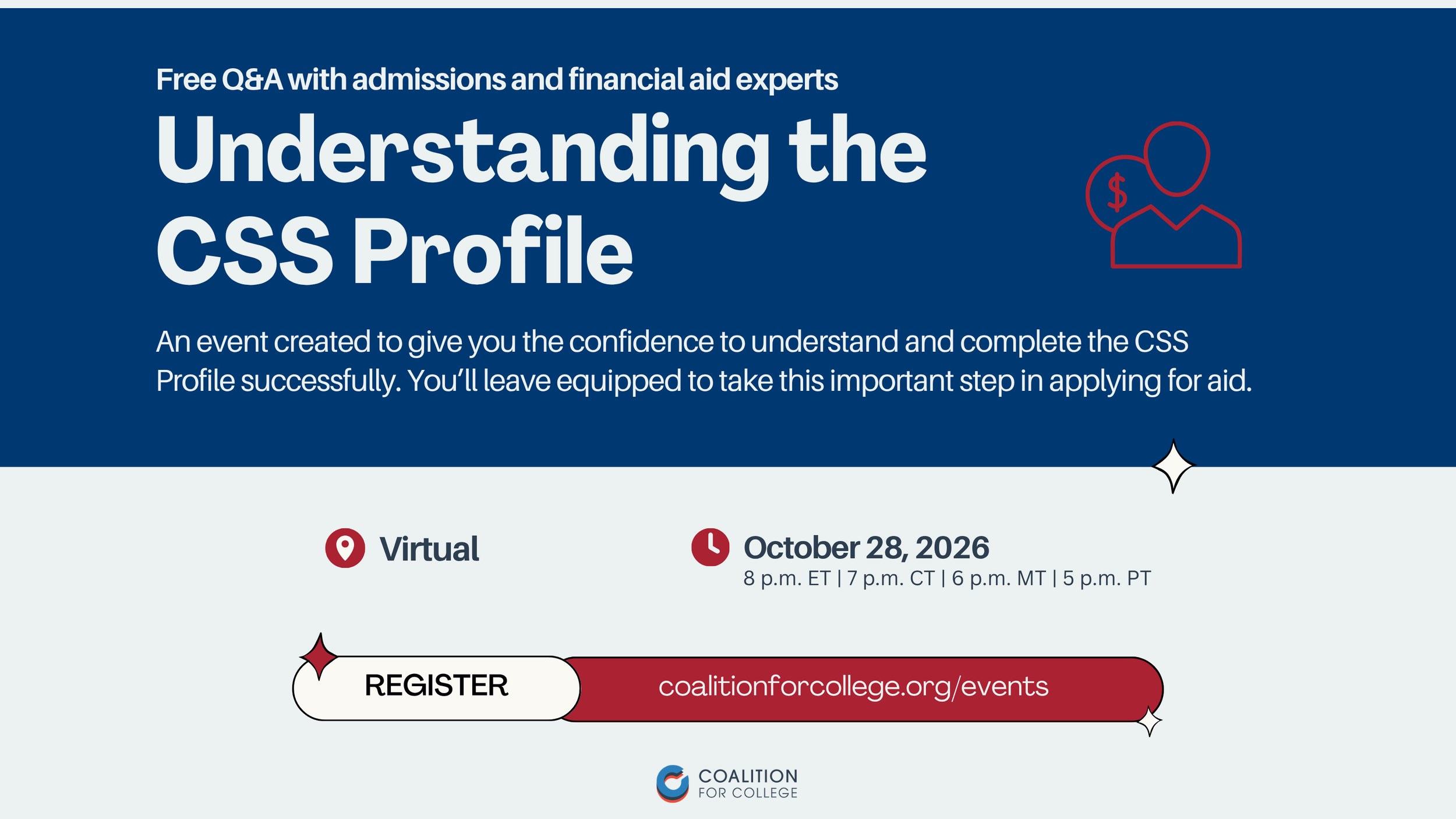
Some colleges on your list may require the CSS Profile in addition to the FAFSA to apply for financial aid. In this panel, admissions and financial aid officers from Coalition member colleges will explain what the CSS Profile is, how schools use it, and tips for completing it successfully. Bring your questions and leave equipped to take this important step in applying for financial aid.
Featuring admissions and financial aid counselors from: Brandeis University, Colby College, Columbia University, and University of Richmond
