

My Coalition Counselor
Everyone needs trusted advice to make it to college. That’s what you’ll find here. Use these resources to understand the college application process from beginning to end.
Choose a category to explore more articles and videos on each topic
Or search for a topic:


For many students, talking about college with family can be one of the most challenging parts of the college search. You might feel pressure to have answers you don’t have yet—or worry that your goals won’t line up with what your family expects.

Fly-in programs offer a unique opportunity for prospective students to experience campus life firsthand. These programs, typically sponsored by the institution, are designed to provide an immersive experience that goes beyond the traditional campus tour.
Starting to plan for college shouldn’t just be focused on your senior year. In fact, you’ll be better set up for success and less stressed the earlier you begin. Here’s a checklist of all of the things you can do each year in high school to prepare for a successful college search and application process.


College fairs are a great way to learn about multiple colleges all in one place. They give you the chance to have short, meaningful conversations with admissions representatives and gather information to help you decide which schools may be a good fit. But with so many schools, it can be difficult to know what to ask.

If you’ve started researching colleges, you’ve probably come across lists of college rankings. Rankings can feel like an easy way to compare schools—especially when choosing a college feels high-stakes. But, rankings only show one small piece of the picture.
Understanding what rankings measure, and what they leave out, can help you make smarter, more informed college choices.

When considering your participation in athletics during college, there are a few key aspects of the process that you’ll need to navigate. It’s likely that you have questions about the recruitment process, scholarships, and college conferences, among other things. Here is some information you should know:



The CSS Profile asks the hard questions, and rather than guess on how to answer them, we asked experts from several Coalition member colleges to get you the right answers. In these short videos, financial aid officers decode the most confusing parts of the application. Get the "insider" perspective on everything from home equity to non-custodial parent requirements, straight from the source.

Paying for college can feel confusing—especially when financial aid terms start showing up without much explanation. Work-study is one of those terms that students and families often have questions about.
If you’re not sure what work-study is, how it works, or whether it’s something you should consider, we’ll break it down for you.
Test policies vary from school to school, so it’s important to review the information provided by each of the schools on your list . If you have questions about a college’s test policy, get in touch with its admissions office directly. Admissions officers want to help you make the best decisions!
If you are taking the SAT or ACT, read on for information about these tests and how to prepare for them.

As you research and apply to colleges, you may hear the term demonstrated interest without much explanation. Understanding what it means—and what it doesn’t—can help you focus your time and energy in ways that are actually useful.

Many college applications will ask you some version of, “Why do you want to attend this college?” At first, it can feel straightforward, but students often find it’s one of the hardest questions to answer well.
Admissions counselors aren’t looking for perfect answers or praise about the institution. They’re looking for thoughtful, specific reasons that show you’ve taken time to understand the college.

If you’re considering taking a break after graduating high school and before starting college, you’ve probably heard about gap years. A gap year is a break — usually a year — between high school and college to explore interests, gain experience, or prepare for the next step in life. But how do you know if a gap year is right for you? Let’s break it down.

For many high school students, the journey to college comes with unexpected challenges. Beyond academics, there’s a “hidden curriculum” — unspoken rules and norms that aren’t taught in classrooms or found in syllabuses.

Once you embark on your college journey, there is likely going to be some terminology that you don’t understand.

When you apply to colleges as a transfer student, letters of recommendation serve a different purpose than when you applied to college as a first-year student. That purpose is to show admissions officers that you can handle college-level work right now. Here is what you need to know about getting strong recommendation letters to accompany your transfer applications.

Keep in mind that while many colleges require a transfer essay, some schools make it optional. Always check each school’s requirements first. But if an essay is requested (or strongly encouraged), it’s your best opportunity to show admissions officers why you want to transfer and how their school fits your future.

Whether you’re transferring from a community college or finding a school that better fits your goals, mastering your application timeline is the key to a smooth transition. Unlike first-year admissions, transfer deadlines run on multiple cycles and depend on how many credits you’ve already completed. Here is how to keep your application on track.
Spanish-language resources / Recursos en español


Connect with us at an upcoming event
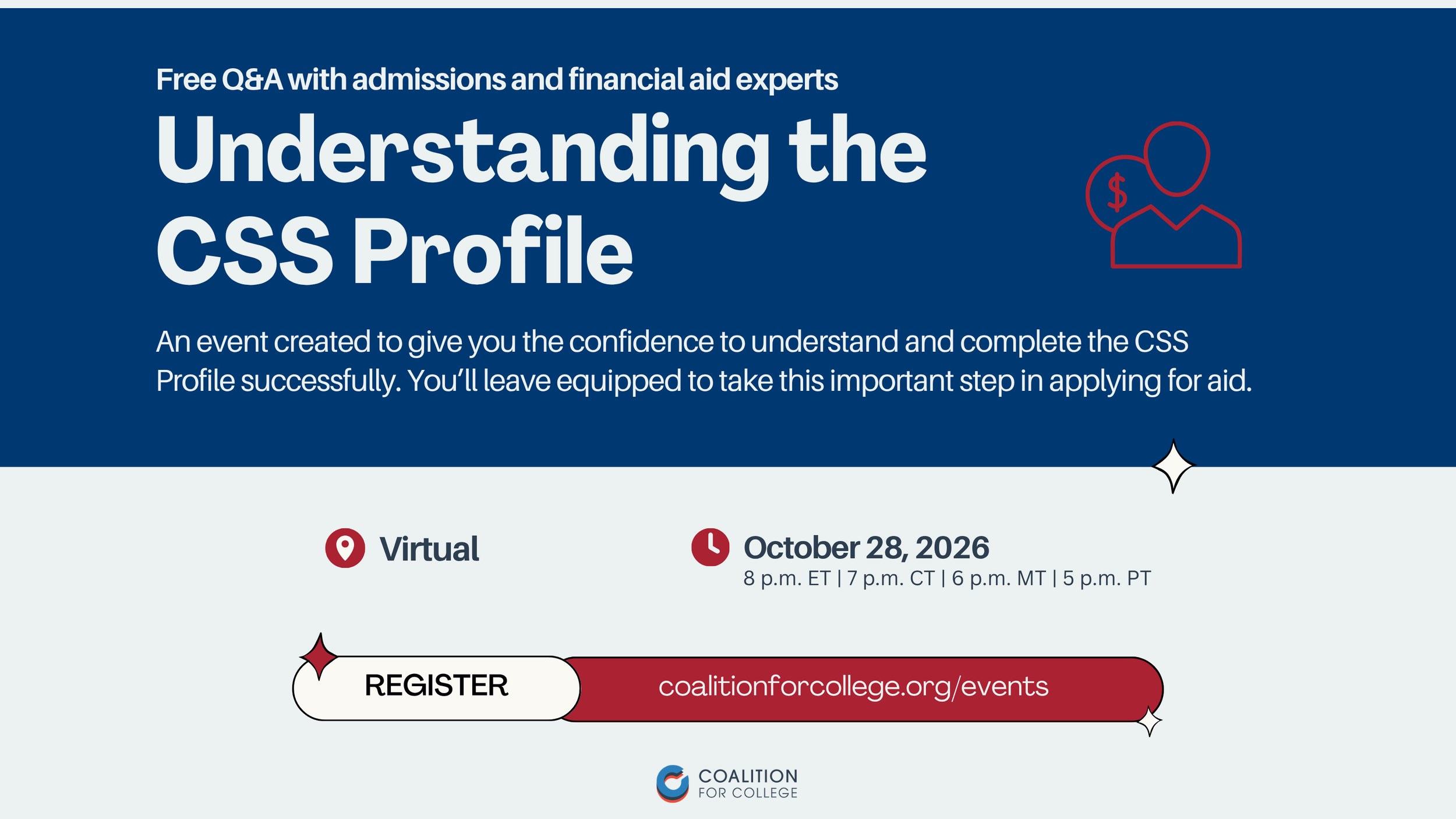
Some colleges on your list may require the CSS Profile in addition to the FAFSA to apply for financial aid. In this panel, admissions and financial aid officers from Coalition member colleges will explain what the CSS Profile is, how schools use it, and tips for completing it successfully. Bring your questions and leave equipped to take this important step in applying for financial aid.
Featuring admissions and financial aid counselors from: Brandeis University, Colby College, Columbia University, and University of Richmond
