
MY COALITION COUNSELOR ADVICE
Preparing to apply
Learn more about how to make the most of your time in high school through coursework selection, extracurriculars, and pre-college programs.

Explore our articles:

For many students, talking about college with family can be one of the most challenging parts of the college search. You might feel pressure to have answers you don’t have yet—or worry that your goals won’t line up with what your family expects.

Fly-in programs offer a unique opportunity for prospective students to experience campus life firsthand. These programs, typically sponsored by the institution, are designed to provide an immersive experience that goes beyond the traditional campus tour.
Starting to plan for college shouldn’t just be focused on your senior year. In fact, you’ll be better set up for success and less stressed the earlier you begin. Here’s a checklist of all of the things you can do each year in high school to prepare for a successful college search and application process.

Expanding college access to communities that have been historically under-represented in higher education is a shared goal among Coalition schools. Many of our members provide pre-college summer opportunities with financial aid available.

Whether it’s to save for college, contribute to your family, or earn extra money for your own needs, you may be considering getting a job as a high school student. Beyond the financial benefits, you’ll also be building a résumé of experiences that could become part of your college applications.

Self worth and evaluation. Being judged by others. An unknown future. Money and finances.
The college admissions process can take us through some uncomfortable areas in our lives, so it’s no wonder it brings up feelings of anxiety.

The grades you earn in high school will be part of what many colleges review when considering your application. Your grades will be reported on your transcript, which is one of the official documents that your high school may be required to provide to the colleges where you apply. Your transcript typically shows the grades you earn in each class and provides an average of your grades across all of your classes.

When it comes to goals, former college football player and coach Tony DeMeo says, “You get what you set.”
Successful people like Coach DeMeo know that, in order to succeed — in sports, in college, in life — you need to set goals. With goals, you take control of your life. Without them, you lack focus and direction.

In high school, you may occasionally find yourself falling behind in some of your classes. Maybe the teacher is moving too fast, or the work is harder than you expected. Or maybe something’s going on at home that makes studying difficult. Whatever the reason, it’s important to know that there are many free resources available for extra help.

By now, with freshman year behind you, you’ve likely experienced a lot of different extracurricular activities, such as school and/or personal activities, work experiences, and family responsibilities.

Most of your day is spent in school, taking classes and learning new things. But what do you do when the final bell rings and the school day is done?
There are tons of opportunities for you to get involved in extracurricular activities — at school, on your own, in your community — and we encourage you to try out as many as you can!

In high school, you’ll likely take classes in the five core subject areas: English, math, science, history/social sciences, and a language other than English. You may not be required to take a class in each of these areas in every grade, but we strongly recommend that you do. Why? That’s what most college admissions officers are looking for — and it’s what shows them you’re ready for what’s to come in college.
Connect with us at an upcoming event:
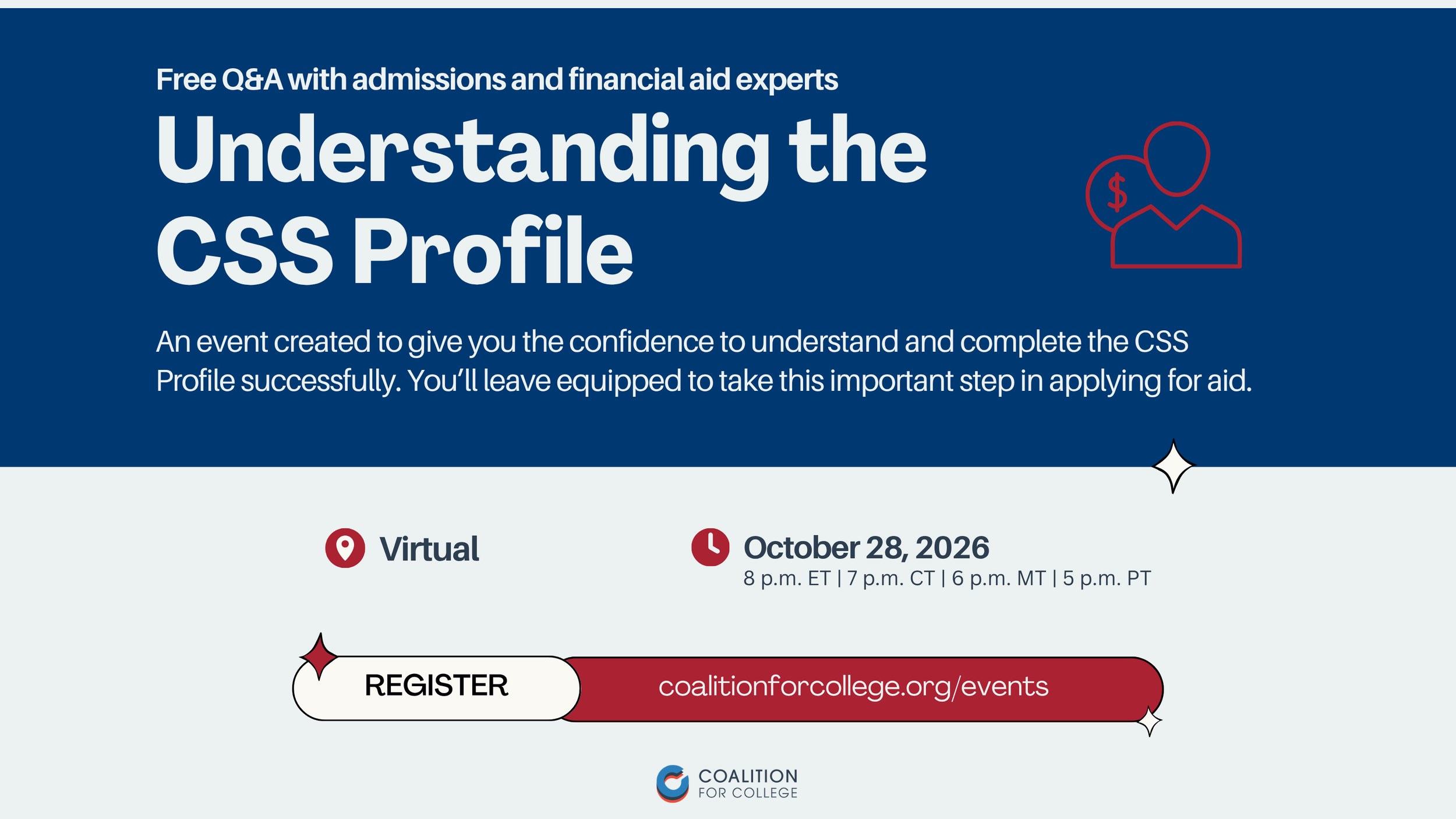
Some colleges on your list may require the CSS Profile in addition to the FAFSA to apply for financial aid. In this panel, admissions and financial aid officers from Coalition member colleges will explain what the CSS Profile is, how schools use it, and tips for completing it successfully. Bring your questions and leave equipped to take this important step in applying for financial aid.
Featuring admissions and financial aid counselors from: Brandeis University, Colby College, Columbia University, and University of Richmond
